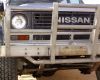
I have recently bought a MQ patrol wagon. I reckon the shocks are buggered but really dont know how to tell for sure without maybe getting them checked by an expert?
The springs look like around 2" lift and are quite hard (ie if i jump on the bull bar it moves about 1 cm). The ride is very harsh and when you go over a bump you feel it twice as the front wheels go over and then the back wheels (typical MQ patrol perhaps? it reminds me of riding in my mates mq shorty years ago)
So because its so hard, it makes it hard to check how the shocks respond however if I rock the car from side to side, by standing on the side steps, once I jump off and stop rocking it, it seems to rock by itself for 4 or 5 times before stopping.
I would have thought it should settle by itself after rocking maybe 1 or 2 more times.
Would this be a reasonable assumption?
Notice: We request that you don't just set up a new account at this time if you are a previous user.
If you used to be one of our moderators, please feel free to reach out to Chris via the facebook Outerlimits4x4 group and he will get you set back up with access should he need you.
If you used to be one of our moderators, please feel free to reach out to Chris via the facebook Outerlimits4x4 group and he will get you set back up with access should he need you.
Recovery:If you cannot access your old email address and don't remember your password, please click here to log a change of email address so you can do a password reset.
How to tell if your shocks are stuffed?
Moderators: toaddog, TWISTY, V8Patrol, Moderators
This will be good to know.
I've read that if you can push down on the side of a car it should go straight back to the spot it should be.
it shouldn't keep rocking etc.
I was also thinking maybe measure the top of the wheel wells and see if they are the same around the car, as a way of seeing if the front or rear is sagging too much.
It'll be interesting to see what other say though.
I've read that if you can push down on the side of a car it should go straight back to the spot it should be.
it shouldn't keep rocking etc.
I was also thinking maybe measure the top of the wheel wells and see if they are the same around the car, as a way of seeing if the front or rear is sagging too much.
It'll be interesting to see what other say though.
The only way to make sure if the are stuffed is to remove them and see what resistance there is in both directions.Should be dam hard to move the piston.If you can hold the shock at one end and the rod slides out freely it is realy stuffed,You could wait until one siezes ,as one of mine did.Then there is no questions.
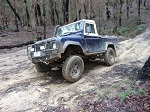
Hybrid rover ute. Isuzu diesel. Custom suspension. Winch. Snorkel etc. etc.
Here is how to properly test your shock absorbers 
http://www.me.mtu.edu/~mrao/et-shock-paper.pdf
Simple observation will tell you a lot about the condition of the shock absorbers: What does the vehicle drive like (ie does it pogo over bumps or after sudden braking)?
Does it lurch around corners?
Check the shock is not bent, broken or leaking.
Remove the shock and push it in and pull it out to check the damping (keep the shock upright). Compression should be easier than rebound and it should feel smooth over the length of travel. If there is no resistance or the shock binds in places it should be replaced.
The bump test is also a good indicator on normal passenger vehicles, but can be more difficult to do on stiffly sprung larger 4X4s etc. Push your weight down as in bouncing each corner of the vehicle and let go. It should stop quickly within 1 to 2 oscilations. If it continues bouncing, replace the applicable shocks.
If your shocks are adjustable for damping and are set incorrectly it can introduce other problems.
http://www.me.mtu.edu/~mrao/et-shock-paper.pdf
Simple observation will tell you a lot about the condition of the shock absorbers: What does the vehicle drive like (ie does it pogo over bumps or after sudden braking)?
Does it lurch around corners?
Check the shock is not bent, broken or leaking.
Remove the shock and push it in and pull it out to check the damping (keep the shock upright). Compression should be easier than rebound and it should feel smooth over the length of travel. If there is no resistance or the shock binds in places it should be replaced.
The bump test is also a good indicator on normal passenger vehicles, but can be more difficult to do on stiffly sprung larger 4X4s etc. Push your weight down as in bouncing each corner of the vehicle and let go. It should stop quickly within 1 to 2 oscilations. If it continues bouncing, replace the applicable shocks.
If your shocks are adjustable for damping and are set incorrectly it can introduce other problems.

Who is online
Users browsing this forum: No registered users and 2 guests