Where I live in Vic ......it rains for 9 months of the year and drips off of the trees the other three ! .....
Wet welding rods arent a pleasure to use but they still work fine, the 120 amps you were running would have dried em out in the first 2 inches of welding !!!!
As for the poor welds you have now,
Arc is a much more tollerant welder when it comes to shyte on the surfaces be it paint/gal/rust/oil/grease/cement etc etc etc, it will by and large "burn through" the crap to find the steel beneath. But for a "L"plater welder

cleaning up around the weld will give you another advantage.
Migs are really susceptible to crud on the materials surface to the point where I grind brand new steel to reveal the shinny stuff below ..... in this case I'm removing what is called "Mill Scale" ...... Every bit of "black steel has mill scale on it and migs dont like it much...... for those in the game I do this on structal beams IE: 200UB and up where connection plates are attatched, the connection plates, usually 16mm and up in thickness are also ground to remove the mill scale.
Have you change something else either the welder, style, even a change in the powerpoint can effect welding performance. Where i live there are some other "heavy" electrical users on the same line, as a result there are times that they have some serious gear going and it sucks the power dry to the point where my mig may be set at 220 amps but it will be really only putting out 80 amps !!!. I've had times here where I couldnt even shake the molten drop off of the end of the arc welding rod !......
These things dont sound like much but DO effect performance and end result.
The querry about verticle ups versus verticle downs .....
There is far more strength in an "up" over a "down", reason being that 99% of ppl make only 1 pass on the "down" so it lacks what is known as "fillet" or in laymans terms "size .... thickness ....width etc etc."
Several passes using the verticle down will build up the fillet to an equal size and thus dramatically increasing strength. This style is used mainly for chassis welding where a down pass is made then ground back and the process is repeated yet again as many times as is required to enlarge the weld to the correct size fillet. Verticle downs generate much less heat within the material being welded so there is a far less likelyhood of distortion and therefore stress, compared to an up pass.
I have seen too many "stress fractures" on truck chassis's from ppl doing verticle ups, sure they welded it but the cracks always show up down the track.
Oh yeah.....
Fillet welds are measured therefore have a size ......
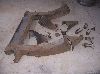
Judging by your pics and taking a blury guess
it looks as if you used 50x6 plates in your practice welds. At a stab in the dark Id guestamate the fillet is around a 3mm fillet weld ....you'll work it out from there I'm sure.
Kingy
[color=blue][size=150][b]And your cry-baby, whinyassed opinion would be.....? [/b][/size][/color]